2026 Best Roll Label Paper Types for Global Buyers?
Choosing the right Roll Label Paper can influence print quality, shelf appeal, storage life, and total purchasing cost. For global buyers, the decision involves more than selecting a bright white surface. Material grade, adhesive compatibility, roll width, core size, winding direction, and printing technology must work together.
This guide examines the leading roll label paper types expected to matter in 2026. It considers semi-gloss, matte, thermal, kraft, coated, and recycled options for food packaging, logistics, retail goods, and industrial applications. Each type performs differently under heat, moisture, friction, and repeated handling. A freezer label may need strong adhesion during condensation, while a premium cosmetic label may require a smooth surface for fine graphics. Small details matter.
Experienced purchasing teams should request samples before approving large volumes. Test them on the actual printer, ink, die-cutting equipment, and packaging surface. Check roll tension, edge alignment, barcode readability, and adhesive transfer after storage. Even experienced teams get this wrong. Paper that performs well in a supplier’s sample room may curl after ocean transport or lose adhesion in a humid warehouse. Certification claims also deserve careful verification, especially for recycled content and product-contact applications. No single paper type fits every market. Regional climate, labeling equipment, shipping conditions, and customer expectations can change the best choice. This overview offers a practical comparison, while recognizing that real production trials remain essential.
What Is Roll Label Paper and How Is It Classified?
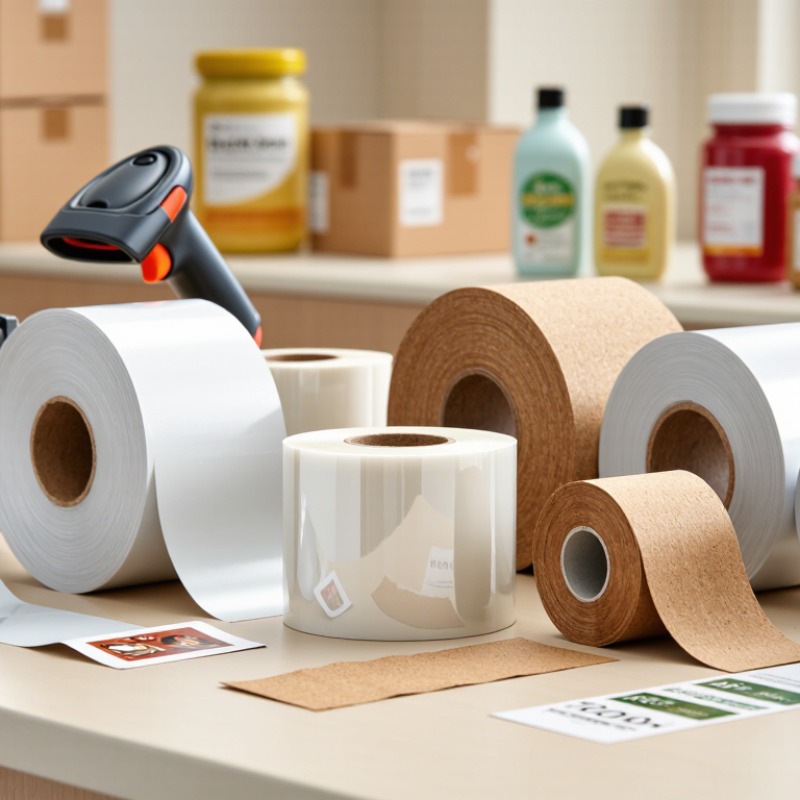
Roll label paper is a continuous paper web wound around a core. Printers unwind it, print the design, and cut or dispense individual labels. Unlike sheet labels, roll stock supports faster production and automatic application. A typical roll has three layers: face stock, adhesive, and release liner. Some constructions remove the liner to reduce waste.
Classification usually begins with the face material. Standard uncoated paper suits cartons, files, and short-term indoor labels. Coated paper gives sharper text and smoother color areas. Thermal paper develops an image through heat, so it needs no ink ribbon. It works well for receipts and temporary logistics labels. Synthetic roll stock resists water, abrasion, and tearing better than paper, although it often costs more.
Adhesive creates another important category. Permanent adhesive bonds firmly, while removable adhesive supports clean repositioning. Freezer-grade adhesive performs differently on cold, damp surfaces. Buyers should also check roll width, core diameter, outer diameter, winding direction, and printer compatibility. In humid storage rooms, paper can curl before printing. I have seen a correct-looking specification fail because the liner released unevenly. No classification is perfect. Real testing still matters. A small trial roll can reveal dust, edge damage, poor contrast, or adhesive failure before a large international order.
Which Roll Label Paper Types Suit Different Printing Methods?
For global buyers, roll label paper should match the printing method, not merely the product’s appearance. FINAT’s 2024 Radar reported a 2.1% decline in European self-adhesive label demand during 2023. That pressure makes material selection more important.
Flexographic printing suits coated or semi-coated paper with controlled absorbency. It delivers sharp text, stable solids, and efficient long runs. Uncoated paper works well for natural textures, but ink spread can soften small details. Sheet-fed and web offset printing favor smooth, dimensionally stable coated paper. It supports fine images and balanced color density, though drying conditions need careful control. Small errors become expensive.
Digital inkjet usually performs best with ink-receptive coated paper. Without suitable treatment, ink may feather or dry unevenly. Digital toner systems often need smooth paper with strong surface strength and controlled moisture. Thermal-transfer printing requires a compatible topcoat, especially for variable data and warehouse labels. Direct thermal paper is practical for short-life applications, but heat, light, and abrasion can reduce readability. It is not a universal solution.
Smithers’ global label market research continues to identify digital printing as a major growth area, while conventional processes remain important for volume production. In practice, I would test roll tension, curl, drying, and barcode contrast before ordering at scale. Laboratory data helps. Real production conditions still disagree sometimes.
How Do Material, Adhesive, and Finish Affect Label Performance?
Choosing roll label paper in 2026 requires more than comparing price and brightness. Material, adhesive, and finish work together under real handling conditions.
Paper labels suit cartons, jars, and indoor products with dry storage. They print with crisp text and often support efficient high-speed application. However, ordinary paper may wrinkle near condensation or rough surfaces. A coated face can improve color density, while an uncoated surface often feels easier to write on. No material wins every time.
Adhesive selection depends on temperature, surface energy, and application speed. Permanent adhesive usually performs well on clean cardboard and glass. Removable adhesive can protect temporary labeling needs, but it may lose grip on dusty surfaces. I have seen a label pass a room-temperature test and fail after a cold-chain transfer. That mistake taught me to test the actual surface, not a sample sheet. Small details matter.
Finish changes both appearance and durability. Gloss can strengthen shelf impact, while matte paper reduces glare under warehouse lighting. A protective coating may resist light moisture and scuffing, but it can affect handwriting and recyclability decisions. Test rolls should face rubbing, stacking, humidity, and temperature changes. Keep records of peel strength and edge lifting. The best specification is not always the most expensive one. Sometimes, buyers choose a beautiful finish that slows scanning or exposes weak adhesion. That deserves a second look.
What Are the Best Roll Label Papers for Major Global Applications?
For major global applications, roll label paper should match the product, press, and supply route. Uncoated kraft paper suits cartons, bakery packs, and natural-looking retail labels. It offers strong fiber character, but ink absorption can reduce barcode sharpness. Semi-gloss coated paper gives cleaner colors for food, household, and personal-care packaging. Thermal paper supports variable information, logistics, and retail scales without ribbon-based printing. Direct thermal is efficient, but heat and sunlight can darken the image.
Smithers’ global printed labels research identifies packaging growth, digital printing, and shorter production runs as important market drivers through the decade. FINAT’s 2024 market reporting also highlights pressure from material costs and changing order patterns in Europe. These findings suggest that converters need flexible paper specifications, not one universal grade. In practice, I would test moisture resistance, adhesive anchorage, die-cutting, and roll humidity before approving a large order. Paper choice is often judged too late.
Tips: Ask for caliper, basis weight, brightness, opacity, and core dimensions. Check the supplier’s technical data sheet and request a press trial. For chilled products, test condensation exposure for 24 hours. Recycled content can improve sustainability claims, but it may affect formation, stiffness, and print uniformity. That trade-off deserves honest review. A beautiful sample can still fail during high-speed application.
2026 Best Roll Label Paper Types for Global Buyers
Basis weight is a practical comparison point when selecting roll label paper. Lighter papers support efficient dispensing and lower material use, while heavier or wet-strength papers provide better durability for demanding environments.
Typical ranges shown are commonly specified commercial basis-weight ranges measured in grams per square metre (gsm). Actual performance also depends on adhesive selection, coating, printing process, humidity, temperature, and end-use requirements.